

 Image 1 of 1
BREWING RECOMENDATION
RECIPE:
Brew Ratio: 1:17
Dose: 30 grams
Brew water: 510 ml
Brew temperature: 100ºC (freshly boiled)
Brew time: 3-4 min (depending on your grinder)
Serves two people.
Country: Kenya
Region: Kirinyaga
Altitude: 1700 masl
Process: Washed
Varietal: SL28 & 34, Riuru 11
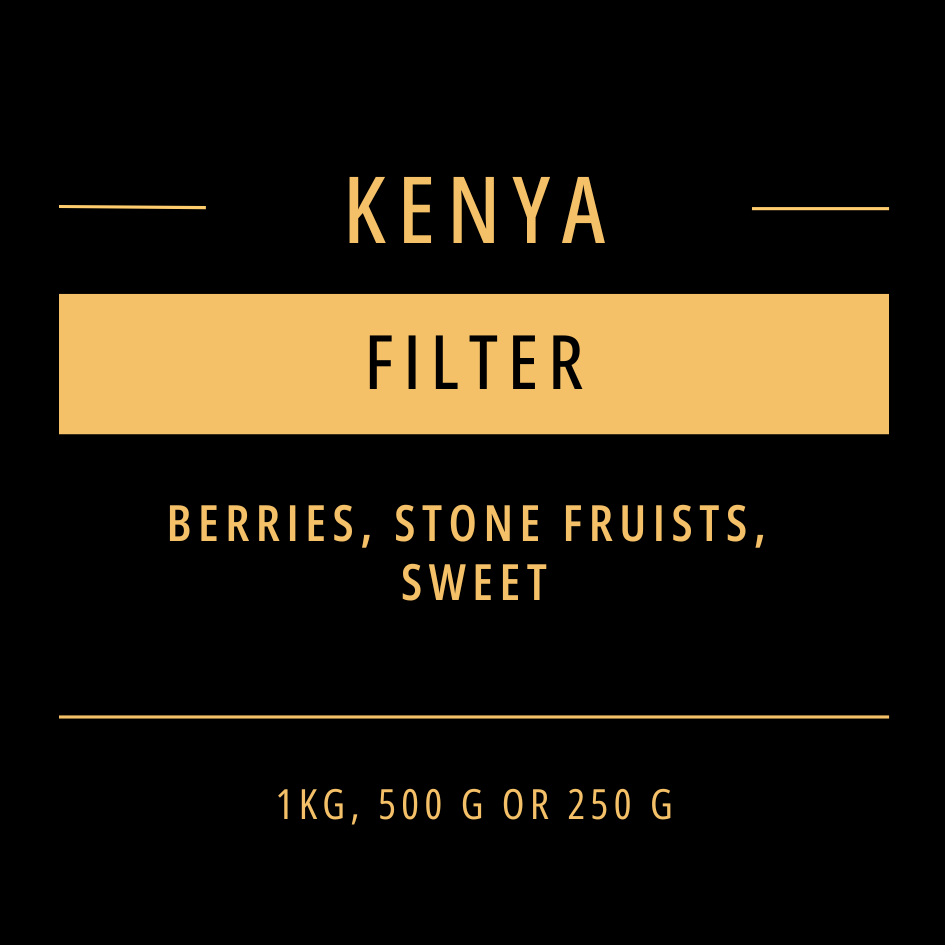
CupProfile: Berries, Stone Fruits, Sweet
ABOUT THIS ORIGIN
Kimatu Factory sits in Njukiini ward, in the eastern reaches of Kenya's Kirinyaga region, where a favourable microclimate encourages the slow development of dense, sweet cherry. The station operates under the Rwama Farmers Cooperative Society, which also runs the neighbouring Muthigiini and Muburi wet mills, and draws cherry from roughly 800 smallholders who farm at approximately 1,700 metres above sea level. At this elevation, and on the fertile volcanic soils that characterise Kirinyaga, coffee matures gradually and builds the concentration of sugars that underpins the region's reputation for cup quality.
The farmers delivering to Kimatu cultivate a mix of SL28, SL34, Ruiru 11 and Batian. The first two are prized for their layered complexity, bright fruit character and vivid acidity, while the latter two are newer, disease-resistant selections bred for resilience and productivity. Batian, released by Kenya's Coffee Research Institute in 2010 and named after the highest summit of Mount Kenya, resists both Coffee Berry Disease and Coffee Leaf Rust and begins bearing fruit after only two years. Ruiru 11 shares that early maturity and disease tolerance alongside notably high yields. The SL cultivars, by contrast, trace back to the selection work carried out at Scott Agricultural Laboratories during the 1930s and 1940s; their deep root systems allow them to draw on limited groundwater and thrive without irrigation, which helped make them a mainstay for Kenyan growers.
Cultivation increasingly follows Good Agricultural Practices, with producers working to keep their environmental footprint as light as possible. At harvest, smallholders pick selectively, taking only ripe cherry before delivering it to the factory. There, the cherry is hand sorted by sight to remove defects and floated to separate out underripes. Sound cherry is then pulped and left to ferment for twelve to eighteen hours, after which the parchment is washed in clean water and moved to raised beds or solar dryers for ten to fourteen days. Throughout drying, workers rake the parchment regularly to promote even moisture loss and guard against over-retention, continuing until the coffee reaches its target moisture level.
Country: Kenya
Region: Kirinyaga
Altitude: 1700 masl
Process: Washed
Varietal: SL28 & 34, Riuru 11
CupProfile: Berries, Stone Fruits, Sweet
ABOUT THIS ORIGIN
Kimatu Factory sits in Njukiini ward, in the eastern reaches of Kenya's Kirinyaga region, where a favourable microclimate encourages the slow development of dense, sweet cherry. The station operates under the Rwama Farmers Cooperative Society, which also runs the neighbouring Muthigiini and Muburi wet mills, and draws cherry from roughly 800 smallholders who farm at approximately 1,700 metres above sea level. At this elevation, and on the fertile volcanic soils that characterise Kirinyaga, coffee matures gradually and builds the concentration of sugars that underpins the region's reputation for cup quality.
The farmers delivering to Kimatu cultivate a mix of SL28, SL34, Ruiru 11 and Batian. The first two are prized for their layered complexity, bright fruit character and vivid acidity, while the latter two are newer, disease-resistant selections bred for resilience and productivity. Batian, released by Kenya's Coffee Research Institute in 2010 and named after the highest summit of Mount Kenya, resists both Coffee Berry Disease and Coffee Leaf Rust and begins bearing fruit after only two years. Ruiru 11 shares that early maturity and disease tolerance alongside notably high yields. The SL cultivars, by contrast, trace back to the selection work carried out at Scott Agricultural Laboratories during the 1930s and 1940s; their deep root systems allow them to draw on limited groundwater and thrive without irrigation, which helped make them a mainstay for Kenyan growers.
Cultivation increasingly follows Good Agricultural Practices, with producers working to keep their environmental footprint as light as possible. At harvest, smallholders pick selectively, taking only ripe cherry before delivering it to the factory. There, the cherry is hand sorted by sight to remove defects and floated to separate out underripes. Sound cherry is then pulped and left to ferment for twelve to eighteen hours, after which the parchment is washed in clean water and moved to raised beds or solar dryers for ten to fourteen days. Throughout drying, workers rake the parchment regularly to promote even moisture loss and guard against over-retention, continuing until the coffee reaches its target moisture level.

BREWING RECOMENDATION
RECIPE:
Brew Ratio: 1:17
Dose: 30 grams
Brew water: 510 ml
Brew temperature: 100ºC (freshly boiled)
Brew time: 3-4 min (depending on your grinder)
Serves two people.